
Skip to content

Good to know

Overthinking and Rumination: How to Break Free from Intrusive Thought Loops

Author: The Tester.lt team

Do you replay past conversations or invent worst-case future scenarios? Learn what drives overthinking — and take the free test.

Key takeaways

  • Overthinking is an exhausting process in which the mind gets stuck in repeating thought loops that do not lead to concrete action or decisions.
  • Psychology usually describes three main forms: analysing past mistakes (rumination), inventing worst-case future scenarios, and decision paralysis.
  • Although the brain uses this process as an attempt to avoid mistakes and stay in control, it actually fuels chronic stress, insomnia, and emotional exhaustion.
  • To interrupt the cycle, recognise your dominant thinking pattern and use targeted attention-shifting and boundary-setting techniques.
Overthinking and rumination: techniques for managing intrusive thoughts

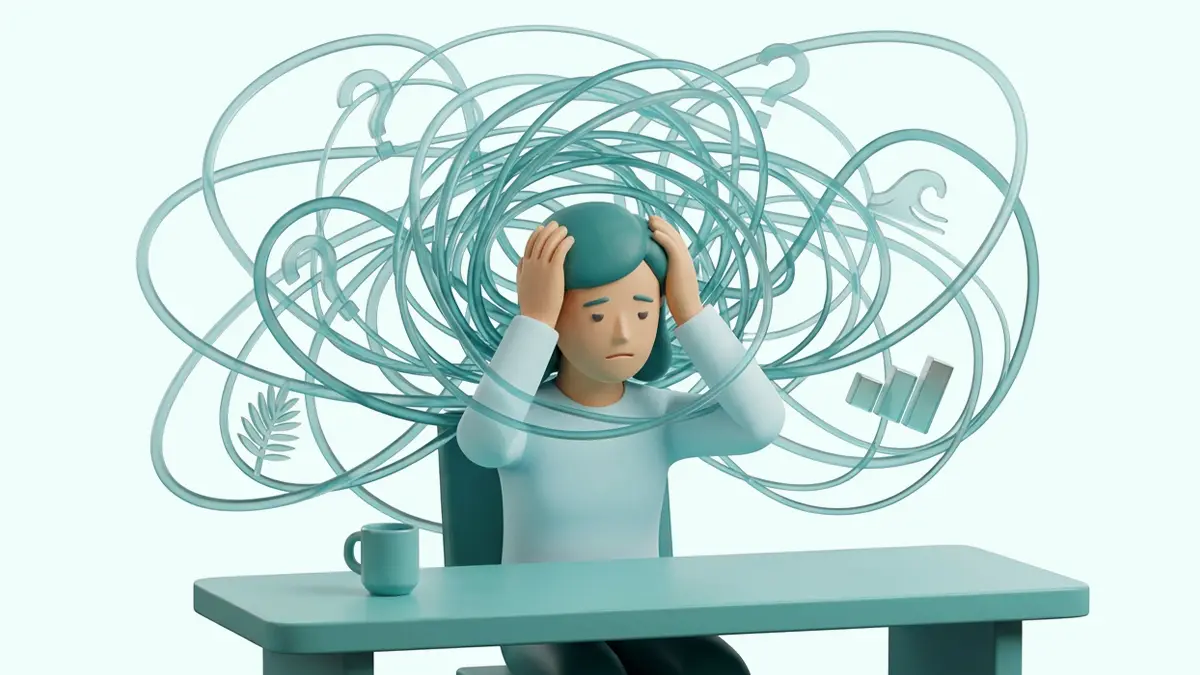
You lie down after a long workday, or you try to focus on an important task, and suddenly your brain shifts into top gear. A conversation with your manager from a few days ago starts looping; an unanswered email resurfaces; worry about next year’s finances flares up. You analyse every word, weigh alternatives, hunt for hidden meanings — and an hour later you feel completely drained, even though you never left your seat. Psychology calls this process overthinking: the natural human ability to analyse and plan turning against itself.

Self-reflection or thought traps: where does constructive thinking end?

Reflecting on past experience and planning ahead are among the mind’s greatest strengths. The line between healthy self-reflection and exhausting mental loops, though, is thin. The real difference lies in purpose and outcome.

Constructive thinking is directional. You assess the situation, draw conclusions, make a decision or build an action plan — and tension eases. Overthinking is an unproductive, repeating cycle of negative thoughts. You return to the same questions again and again, often with no single answer available, and the only result is higher anxiety, self-criticism, and emotional fatigue. These loops are often fed by cognitive thinking traps — automatic distortions that paint a situation worse than it really is.

Three forms of overthinking: where does the mind get stuck?

From the outside the process looks the same — someone lost in thought and withdrawn — yet cognitive psychology distinguishes three directions intrusive thoughts tend to take.

1. Past rumination (stuck on what already happened)

How it shows up: the term rumination was popularised by Yale psychologist Dr. Susan Nolen-Hoeksema. Literally it means chewing cud — returning stomach contents to chew again. In psychology it appears as compulsive replaying of past events, mistakes, embarrassing moments, or hurts. People keep asking: “Why did I say that?”, “What did others think of me?”, “What if I had acted differently?”

Impact: because the past cannot be changed, the process offers no practical benefit. It only keeps guilt and shame active, lowers self-worth, and blocks the ability to solve problems in the present.

2. Future worry and catastrophising (modelling threats)

How it shows up: this mind lives mostly in the future, building complex and usually negative scenarios. The engine is the question “what if…”. Before a conversation, a trip, or a new project, the brain generates dozens of ways things could go wrong. Even a small surprise — a partner’s delayed text — can trigger a chain of frightening assumptions.

Impact: the brain struggles to separate a real physical threat from a vividly imagined scenario. By modelling future disasters, you make your body release stress hormones (cortisol and adrenaline) here and now. That leads to chronic muscle tension, digestive issues, and insomnia — symptoms that often overlap with chronic stress .

3. Decision paralysis (hyper-analysis)

How it shows up: fear of being wrong becomes stronger than the wish to act. Faced with a choice — from a household purchase to a career direction — the person sinks into endless research, reviews, and pros-and-cons lists. Every new detail creates more doubt. Even after deciding, calm does not arrive: the mind keeps analysing whether the rejected option would have been better.

Impact: constant hyper-analysis burns a huge amount of cognitive energy. Important work gets postponed, opportunities are missed, and everyday decisions become a heavy psychological load. If delaying becomes a habit, it helps to look at procrastination types — decision paralysis often hides fear of mistakes or perfectionism.

Why we do this: the illusion of control

If overthinking is so draining, why doesn’t the brain simply stop? Evolution designed the mind for survival, not happiness. For our ancestors, remembering where a predator appeared (past analysis) and predicting where it might appear tomorrow (future modelling) meant staying alive.

In the modern world physical threats have decreased, but social and informational uncertainty has grown. When we feel unsafe or tired, the brain switches on overthinking as a protective mechanism. Unconsciously it feels as if spinning the problem long enough will produce an exit, prevent criticism, and secure total control. That control is illusory — we only trap ourselves inside our own thoughts. For highly sensitive nervous systems the cycle is often even more intense; see our article on the highly sensitive person (HSP) .

Practical techniques to interrupt intrusive thought streams

Stopping a spinning thought loop by willpower — or by telling yourself “don’t think about it” — is almost impossible and usually raises tension. Psychological methods that change your relationship with thoughts work far better:

  • Scheduled “worry time”. Instead of fighting anxious thoughts all day, give them a concrete 15–20 minute window. When an intrusive thought appears earlier, jot it down briefly and tell yourself you will return to it at the planned time. When that hour arrives, allow yourself to write everything out. By then, many thoughts have already lost their urgency.
  • The two-minute and deadline rule (for decision paralysis). Create firm frames for information search. If a decision will not matter in a month, make it within two minutes. For larger decisions, set a clear research window in advance (for example two days), then choose among the options you have.
  • Switch the question from “why?” to “how?”. Past rumination feeds on passive questions: “Why did this happen to me?” Replace them with action-oriented ones: “How can I resolve this now?” or “What specifically will I do differently next time?” If the answer requires action — take it; if the situation can no longer be changed — that is your signal to stop analysing.
  • Physical grounding of attention. Because overthinking happens in the head, the fastest interrupt is returning attention to the body and physical sensations. A brisk walk, cold water, breathing exercises, or any activity that needs concentration forces the brain to shift resources from inner dialogue to the outer world. Sometimes what you need is deliberate sensory or mental rest , not another attempt to “think the problem through”.

Want to know which of the three thought-trap forms fits you most? Take the free overthinking and rumination test . After 15 questions you will see your thinking profile and get clear recommendations for reclaiming calm.

Sources

  • Nolen-Hoeksema, S., Wisco, B. E., & Lyubomirsky, S. (2008). Rethinking rumination. Perspectives on Psychological Science, 3(5), 400–424.
  • Ehring, T., & Watkins, E. R. (2008). Repetitive negative thinking as a transdiagnostic process. International Journal of Cognitive Therapy, 1(3), 192–205.
Adult ADHD test: illustration of attention and hyperactivity symptoms
Psychology

ADHD in Adults: Symptoms, Causes, and How to Recognise It

Adult ADHD can hide behind dozens of open tabs, unfinished projects, and constantly misplaced keys. Learn the main signs, causes, and next steps.

Read article
Emotional burnout test: illustration of professional exhaustion and chronic stress
Psychology

Burnout: Warning Signs, How It Differs from Stress, and What to Do

Is a restful weekend no longer enough, while Monday morning already fills you with apathy? Distinguishing temporary fatigue from burnout is the first step towards preventing severe exhaustion.

Read article

Another discovery

Want another discovery?

If you’re still unsure where next — let chance pick an unexpected test for you.

One tap — one unexpected test.