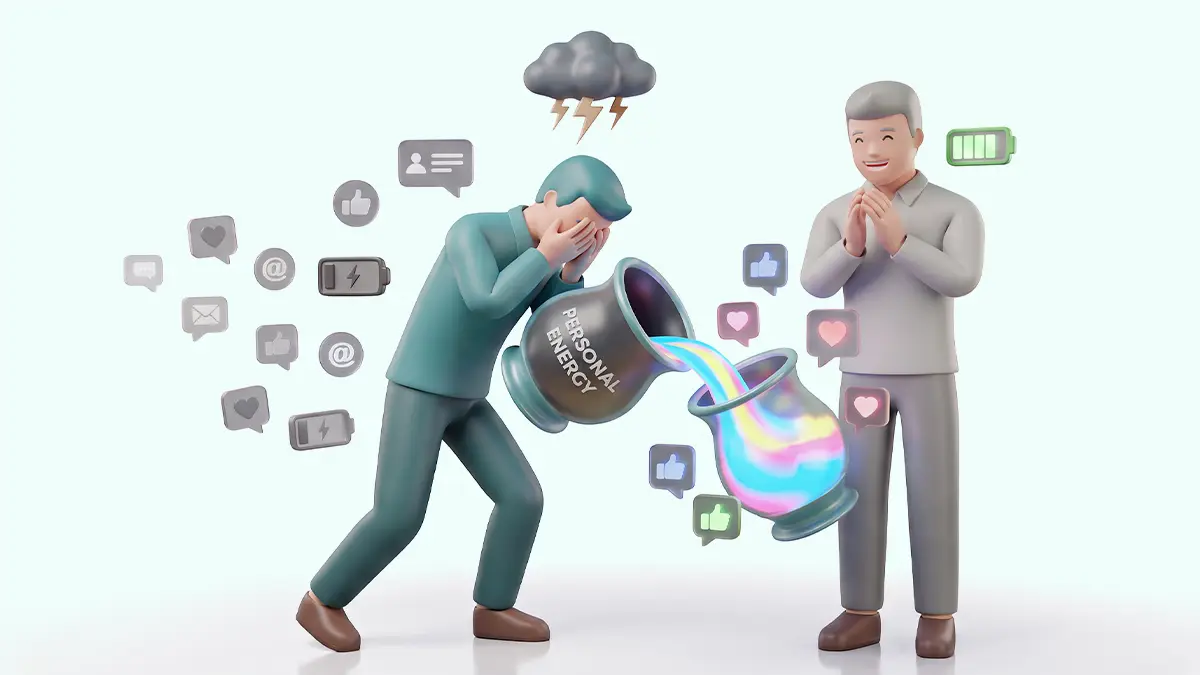
Relationships should be a space where both partners feel safe, supported, and free to be themselves. Sometimes that harmony becomes an illusion, and the wish to help a loved one turns into hard labour. If you notice that your life has come to revolve exclusively around your partner’s problems, while personal interests have neither time nor energy left, it is worth paying attention. You may be facing codependency in relationships. This is a dynamic in which love is mixed with constant rescuing, and personal boundaries gradually dissolve into another person’s needs.
What is codependency in relationships?
Codependency in psychology is treated as a deeply rooted behaviour pattern, often learned in childhood. It is a situation in which a person feels excessive responsibility for another’s actions, emotions, and overall wellbeing. Such a mechanism often forms in an unpredictable environment where a child had to guess parents’ moods and adapt to them to keep peace at home. In adulthood, similar patterns sometimes connect with attachment styles —especially when fear of rejection drives constant accommodation of the other person.
In adult romantic relationships this shows up clearly. A person with strong codependent tendencies measures personal worth through usefulness. They feel valuable only when needed by their partner. They constantly try to anticipate the other person’s wishes, rush to smooth over conflicts, and instinctively avoid friction. Living this way creates a fear: if I stop controlling or supporting everything, the relationship will simply fall apart.
Signs of codependency: how to recognise the “rescuer” syndrome
Codependency in relationships rarely begins suddenly. It usually builds gradually, disguised as sincere care and self-sacrifice. Here are several concrete signs of codependency that reveal fading personal boundaries:
- Constant guilt about time for yourself. After meeting friends, reading a book, or exercising, a nagging anxiety appears. It feels as if you “stole” that time from the relationship, when you should really be doing something useful for your partner.
- Taking on someone else’s responsibility. If your partner faces difficulties at work or in personal life, you experience those problems more intensely than they do. You frantically search for solutions, make calls, arrange things. You start living their life and take responsibility away from them.
- Fear of saying “no.” Disagreeing with a partner’s opinion or declining a request feels like a huge risk of conflict. To keep the peace, you regularly stay silent about your view and agree to decisions that do not actually suit you. If this point feels especially familiar, it also helps to explore personal boundaries and the ability to say “no” .
- Emotional mind-reading. You act like a radar, constantly scanning your partner’s facial expressions, sighs, and tone. Any dip in their mood instantly becomes your problem, and you feel obliged to fix it as quickly as possible.
- Ignoring yourself. Asked what you most want right now, you would probably struggle for an answer. Your personal desires have become identical to your partner’s.
Healthy care or codependency: where to draw the line?
Supporting a partner through difficulty is essential in every stable relationship. That is why people often feel confused about how to separate healthy compassion from draining codependency. The key difference lies in responsibility boundaries.
Imagine this situation: your partner overslept and is late for an important
work meeting.
Healthy care: You show empathy, say you understand their stress, but
leave them to call their manager and solve the problem themselves. It does
not ruin your own day or productivity.
Codependency: You feel panic as if you yourself had overslept. You
invent an excuse for them, take blame for not waking them, and try to fix
everything on their behalf.
In a codependent dynamic, people often excuse a partner’s negligence. By solving problems before they fully appear, you take away the other person’s chance to experience the natural consequences of their actions. That creates a closed, exhausting loop. You feel increasingly drained and underappreciated, while your partner becomes passive and less confident. When care turns into control, isolation, or constant self-belittling, it is also worth remembering the signs of toxic relationships —sometimes the two patterns overlap.